Showing posts with label Bulgarian Literature. Show all posts

Tuesday, 19 July 2011

Life Can Be a Miracle, says Bulgarian Psychologist Ivinela Samuilova

You must have heard a million times Albert Einstein’s famous thought: There are only two ways to live your life. One is as though nothing is a miracle. The other is as though everything is a miracle. I don’t like it. Probably because miracles haven’t happened to me, or I was too busy being negative to notice them. But I feel that throughout my whole life I have always worked for what I achieved and I have never received anything for granted. Let alone a miracle. Miracles have this unfortunate characteristic of not happening when you most need them. And when (if) they indeed happen, you realize it was a miracle very quite later on. Like the time I met a guy accidentally on the street while reading a book and several months later I had some (un) fortunate relationship with him. But at the time when he asked me whether I liked A Clockwork Orange I didn’t even expect this would turn into some kind of relationship. You may call this a miracle but I realized it might be so quite after that.

Secondly, Einstein’s thought is quite banal and trivial. These quotations never work for me. In my notebook for exquisite thoughts I only write down original, unpopular, unconventional sentences. I never do write the trivial ones because I’ve just heard them way too many times to even notice them. Still, there is one unarguable argument for banal phrases – they are banal because they are sometimes painfully true. So when I received Ivinela Samuilova’s novel Life Can Be a Miracle and I saw Mr. Einstein’s words on it, I felt something boring and trivial was ahead of me, in the style of Bucay or Andrews. However, it was not as bad as expected. Indeed, some parts were worth reading and reflecting upon.


The story is simple. Adi, the heroine (who astonishingly resembles the author herself) has everything in her life – a good job, a loving fiancée, honest friends, and a stable family. She hasn’t experienced any trauma or suffering and she hasn’t endured any sufferings. Her only problem is that she doesn’t know what her vocation is. Similarly, the author has studied religion, economics, administration, PR, journalism, and finally psychologie. Looks like we are dealing here with a confession of how difficult it must be to find a job that suits you. Adi feels something vital and essential for life is missing; her mind is filled with saudade. This is Adi’s favourite Portuguese word, which doesn’t have an equivalent in any language she knows of. It mainly refers to an inexplicable void, to a longing to something that is not there or may not exist, a feeling that something vital is missing. I loved that word. I identified with it. In fact, I read something similar in Nothombs’ The Life of Hunger and ever since this particular expression has become my explanation about what is wrong with me. One red point for Ms. Samuilova.

In order to find her vocation, Adi joins a psychological group with the weird and unconventional Alexei. These psychologists disprove the conventional methods of treatment and insist that Froid was a fool. In other words, you might have had the perfect childhood, the ideal parents, the best friends, and the coolest boyfriend, and still you might be unable to deal with your life. Adi enjoys this explanation and excitedly joins the group to try and find what she is supposed to do.

More or less the novel is predictable and simply written. There are rarely profound and deep investigations, conclusions, or ideas. Most of them we have read in one form or another or we have personally tried and found out they don’t work. The aspect I disliked the most was the concept about miracles. To say it plainly, you can transform anything in your life by writing a letter to the given problem (illness, love issue, work problems, etc) and release it. Adi used this technique upon some of her best friends and it worked immediately. Call me sceptic or cynical but this is never the way the world works. I need a positive book but mostly I need a REALISTICALLY positive book. Not some science-fiction about how happiness is just around the corner and all you need to do is write one f*cking letter.

On the contrary, the idea about “No” is great. We all know (or we should know) that “no” doesn’t work. All psychological books say that you should construct your positive statements avoiding the word “no” because the human mind is constructed in such a way as to avoid it. For example, you shouldn’t say ‘I will not drink beer today’ but instead ‘I will drink only juice today’. The words send positive waves to your brain, which it understands. Samuilova explains this amazingly using the simple example with the squirrel ‘If I tell you not to think about an orange squirrel, what did you just think about? An orange squirrel of course’. This ‘no’ concept also explains why the best way to seduce a woman is to ignore her. Women most of all simply do not get the word ‘NO’!

Samuilova scores another point by explaining with an original metaphor how the way we see the world shapes our life. Basically, she compares our mind to a map. We have a mental map and the world is one big territory. Depending on our map, the territory that will fill it is different. If we offer a positive card we will see that only good things happen to us and vice versa. A more original and interesting way to say that if you expect happiness, that is what you will get and if you only see the worst, the worst will happen to you.

In conclusion, most of Life Can Be a Miracle you have heard a billion times and you will find boring and predictable. However, the books is worth reading for these several passages I mentioned (and maybe a couple more), which offer a different perspective to conventional psychology.

Monday, 27 June 2011

Luizza Hut - A Love Story by the Controversial Toma Markov

"Every decision is a final refusal" (Karl Lagerfeld). Everything that is real is rational. Be careful with love - it is forever. Be careful with love - it is for real. This is Toma Markov and his new novel - a real love novel as he says it - Luizza Hut.

Toma Markov is weird. Everyone who has read him will agree to this point. Mostly famous for his ironical and satirical articles in popular Bulgarian newspapers, the controversial author now surprises with a brand new novel. Not only that, but he brands it "a love novel". The moment I heard about it I knew what I should do - I should buy it for my ex-boyfriend because he is a huge fan. After he read it, he didn't share a single opinion about it with me. He just said: "I want to hear what you think first and I want to read it in your blog". I hope I don't disappoint him.

Markov is Makaronov, the protagonist of the novel. Or Makaronov is Markov, the author who just had issued his first novel and is bearing the fruits of the newly born fame. Bulgaria in the 1998: people have no money, the exchange rate is two bulgarian levs, the mafia is flourishing, drugs are widely available, alcohol and cigarettes are recreational. In that difficult reality Makaronov is trying to balance between his work in the theatre, his literary talent, and his love for Luizza Hut. The front-girl of the most popular punk band at that time is anything but the good girl. Dangerous and promiscuous, Luizza becomes Makaronov's drug, Makaranov's addiction, Makaranov's end. He loves her and hates her; he adores her and despises her; he wants to be with hur and he wants to her her. What is love and how to manage it - Markov (Makaronov) gives un answer to this question, an answer to be felt differently depending on who you are, what you think of love, and how you experience it.

Luizza Hut is an example of what modern Bulgarian literature must be. Brutal, cynical, controversial, but straight to the point. You read Markov and you think "Wait, this is way too vulgar for my taste". And then he says something that makes you stand up in your chair and cry "THIS MAN IS A GENIUS. HE KNOWS WHAT HE IS TALKING ABOUT". Definitely difficult, definitely misunderstood, and definitely haten, Markov marks the beginning of a new novel. One that on a first glance doesn't say much but when you come to think about it, it says a lot. About what love is today. Not the sugar-coated romantic and perfect version American movies desperately try to show it to be. Love is everything that we think it is not. Love is a good of the lovers. Love is what no one every suspects it to be. Love is what makes you happy somewhere else, in some other time. Love is difficult; it is never simple. Love cannot be explained, and sometimes it cannot be understood. And love is cynical and brutal, no doubt about it.

I will be reading more from Markov. This guy knows what he is talking about, he has seen things, he has experienced brutalities, and he has much more to show is. In his typical controversial way of doing so.

Thursday, 16 June 2011

Brutality in the Balkans - Zlatko Enev's Requiem for Nobody


Hard, brutal, cruel, and cynical - this is the requiem of Zlatko Enev. A story about the turbulence in Bulgaria in 1984-1985, followed by the outrages in Serbia and Kosovo, and finished with contemporary Berlin. A story that begins with a French bread and ends with a sacrifice. Painfully honest and painfully realistic, Enev turns towards a shameful period in the Bulgarian history without the proud nationalism and patriotism - to present a picture we must see, although we don't want to believe.

The beginning. The nationalization of the bulgarian turks, who were forced to change their names. The process, which many mistake with patriotism, involved persecutions, murders, and brutalities comparable to the Turkish yoke. Those, who didn't want to abandon their religion or name were persecuted outside the boundaries of Bulgaria. In Turkey they called them Bulgarians, in Bulgaria - turks. They were nobodies - no name, no origin, no belonging to any particular group. This requiem is for them - for the innocent victims of the Bulgarian so called nationalism. People that felt themselves Bulgarians but because of hatred were punished. Enev takes the objective position of an external observer. The author doesn't belong to any ethnic group, he is simply Human. And the actions against the Turks in the 1980s were anything but human.

The women. Beaten, raped, killed, when they even attempted to raise their voice. Maria, the girl who fell in love with a gypsy, an idea unacceptable at that time (and still to be honest) bore the guilt of her beloved's death. Sold as a prostitute by her savage step father, Maria found herself in the Albanian reality. There she was a victim of men's perversities, filming porn movies. Her sufferings are too terrible to describe here. Enev, however, does an incredible job. I had to stop several times while reading because literary I felt the need to throw up. So savage, so brutal, so totally inhuman, Maria's destiny was never to be happy when she finally meets her torturer.

The turk, whose husband is suspected of organizing anti-Bulgarian activities and subsequently killed, falls in love with her rapist. The young girl who becomes pregnant from the local judge is killed by him. The German teacher expelled from Bulgaria because she dared call a turk girl by her own name. None of these outrages against women was punished. There was no system in place to punish the guilty ones. The women were nobodies. Their sufferings were unimportant, their guilt was inherent, and their destiny to suffer was predetermined. This is a requiem for them.

Zlatko Enev's Requiem for Nobody is difficult to read and accept. Yet it is objective (sometimes way too brutal) description of a period in Bulgarian history carefully hidden by communist propaganda. It is not recommended for people with weak nerves.

Sunday, 29 May 2011

Lora from Morning till Evening


I met Lora and I fell in love with her instantly. No, not the Lora I see everyday in the mirror (although most of the time I love her as well). I talk about Dimiter Kocev's Lora and her crazy, exciting, maniacal, amazing day.

Lora is a modern emancipated woman. No, she is not like the heroines from the so-popular chick-lit novels. Lora is not an obsessed workaholic, who is secretly waiting for the white knight to rescue her from her gray daily life. Lora is the young, controversial, feisty girl, whom you could see walking on the street. She can be strong and fragile, crazy and balanced, romantic and realistic. Lora lives alone with her dog Rocky but she doesn't feel lonely. She likes partying all night but sometimes she wakes up in the morning with a hangover, blurry memories, and shame from her actions. Lora gets up to go to work to deal with her nervous boss, annoyingly curious colleagues, and constant charmers, but she is ambitious and she loves her job. And most importantly, Lora loves our city. Yes, despite all of its dangers, oddities, and disorders. The city gives Lora passion and strength; the city is the ideal place for her experience, which I won't forget anytime soon.

Lora from Morning till Evening is a urban story about a typical urban girl. It begins with six magical dies, which can make any decision come true. Lora, Tiho, and Gladkiya are embroiled into an unbelievable adventure to protect and preserve them. Slightly mysterious flavor, a little bit of irony, friendship and love, and lots of thoughts about the meaning of life make Lora from Morning till Evening not merely another novel, but an ode about the city, about the human, about life itself. You will fall in love with Lora, with her independency, with her energy, and with her desire to experience everything. You will not rest until you discover the secret of the magical dies. And you won't leave the novel aside until you drink it on one breath, until you feel it on your skin, until you feel the urge to go out and be part of your city right now.

In addition to being astonishingly good written, the novel is also amazingly decorated. Every page features pictures connected to the story, which make you an indistinct part of the adventure. Soon to be a motion picture, the film will surprise us with its limited budget and lack of the usual suspects (which lately have become increasingly annoying). Instead, the movie is made by friends and for friends. The book and the movie are there to leave us breathless, to infatuate us with this urban experience, and to make us again fall in love with life and with ourselves.

That's what I am looking in a contemporary Bulgarian author - the spirit of the urban streets, the passions of the young man, the events that we encounter every day wondering how to deal with them, the friendship and the love in its purest and real forms. Dimiter Kocev Shosho and Alexander Shpatov bring us exactly this urban feeling we have all been missing. Of course with a little bit of mystery and fantasy to spice the product. The result - a new generation of Bulgarian authors, who knows what the audience wants and most importantly, knows how to take them there.

Friday, 22 April 2011

14 Amazing Short Stories By Alexander Shpatov


Yesterday together with a friend of mine (a blogger and a very good one by the way) we interviewed Alexander Shpatov - the most promising contemporary Bulgarian author. Wrong, we didn't actually interview him, we chatted with him over beer, wine, and pizza. I got to know Alexander the writer, Alexander my ex classmate, Alexander the lawyer, and Alexander the dreamer. We talked casually about literature, books, libraries, the future, the past, our friends, everything. And of course we discussed his last book - Calendar of Stories.

Lately the mediocre and undeveloped Bulgarian culture is witnessing its long expected boom. Movies, TV Series, books, all of them show us that the Bulgarian indeed has talent. I, as a patriot, made it my goal to see and read everything the home talent had to offer. I enjoyed Karabashliev's 18% Gray but Shpatov is better. Not because he is an ex-classmate of mine and not because he is very cute. Shpatov is just entertaining, witty, humorous, ironic, sarcastic. He combines reality with fantasy to arrive at stories about the urban life in Sofia. After all, at the end of the day we are overwhelmed with the American culture and lifestyle. We (ok I) want to read something about Bulgaria, about the Bulgarian character, the Bulgarian issues, the Bulgarian lifestyle. Karabashliev focuses on the clash between home and foreign by following the path of a lost soul through the vast lands of USA. Shpatov offers a different perspective, more enjoyable I must say. He takes us on a journey through the 12 months of the year, each with its own story.

To summarize the collection of stories is impossible. Yet, what all of them have in common is the surprising end. Sometimes it's real, sometimes fantastical, but what it does show is Shpatov's immer imagination. I asked him whether the stories are based on real events. No. All of them come from his mind. Yet, he shared, that after writing certain stories, some of them indeed happened to him.

Calendar of Stories is Shpatov's third book and the most successful one. 12 stories about each of the 12 months plus additional two for Easter and Christmas. Why exactly these two holidays? Because they are the most important, says Shpatov. I can't say which one is my favorite. Probably July. Because it talks about a short-cut to the seaside. Because its ending is unexpected and fantastical. Because we are always looking for a short-cut to somewhere with just a mouse click. We want to arrive there (where?) faster, without superfluous efforts. We want to cheat the system, to find something no one else has, to be better, stronger, more honest, more real, more of everything. With Shpatov I arrived at a place where hard work and hope meet, where the talent can flourish in the body of a lawyer, where your constant struggle and desire for development take you exactly where you must be.

This meeting (not interview!) was inspirational. I will be re-reading Shpatov's stories over and over again because I feel that I have missed something. In fact, I believe that the second time I read Calendar of Stories, it will be a completely different book with completely different stories. Maybe next time I will have another favorite story, which I incidentally missed the first time. Maybe one day Shpatov will interview me. And I will return the gesture by giving him an autograph. Maybe. With a mouse click.

Friday, 15 April 2011

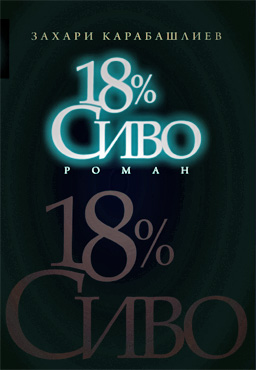
18% Gray - A Nostalgia


The most common thing you are going to heаr about Zachary Karabashliev's 18% Gray is that it is the Bulgarian version of On the Road by Jack Kerouac. As Luben Dilov said it, "On the road. Not with Jack but with Zack.". As a quote it sounds good, almost original, you might say. As a hint towards the topic of the book, it is a complete bullshit.

In 18% Gray the protagonist Zack is indeed on the road. He also takes the famous Route 66 (or what is left from it) as his prominent predecessor. He also travels from the West coast to the East coast, passing through places, people, villages, towns, cities. Zack looks a bit like Jack. And that's about it with the similarities. We don't have our Dean Moriarty here. We have a road ahead of us, sky above us, earth beneath us, and nothing left behind us.

Zack is a man of a transition. The transition between the past and the future, the old and the new, the east and the west, the communism and the democracy. The transition that happened in 1989 (the year I was born!) in Bulgaria that left the country devastated. Zack witnessed the poverty, the difficulties, the crimes, the lack of perspective, the deadlock, the despair, and, like many other Bulgarians, decided to immigrate. From the Bulgarian nightmare to the American dream. With hopes of a bright future, Zack and his wife Stela moved to the US, seeking to release their talent and to find happiness.

He is a photographer, she is an artist. He ends up working in a pharmaceutical company and she ends up leaving him. Zack has lost himself but has found something else - a bag of pot. "Before you find yourself, you have to lose yourself?" No! Before you find yourself, you have to find something else. In this case, a bag of pot.

Are we people of the extremes? Do we live lives in black and white? Can you always say with certainty that one thing is right and the other is wrong? What is the basis, on which you thread, to categorize anything that happens to you? Or do we always live in the middle? 18% gray? 18% gray is the starting point of black-and-white photography. Everything needs a starting point, a basis on which to judge everything else. Darker than 18% by how much %? Or lighter by how much %? Why exactly 18%? Well, why is life that way? Why does life go forward and not backward? Why don't we die first and be born at the end?

18% Gray is a novel of travelling, of losing, searching, and finding. It's a novel of dreams, hopes, love, and rejection. It's a novel of despair. It's a vulgar brutal confession of a man on the road. Man, who has nothing to lose yet so much to find. Does Zack find it the end? Does he know what he is searching for? Can we ever know what we want, and even if we know, can we find it?

This review is full of questions since the novel poses questions. All the time. Questions about life, questions about love, questions about the world. I can't give you the answers. You have to find them in the book. Or at least, start asking yourself the right questions. The only right way to finding what you need is to ask the right questions. Before that you may ask a lot of wrong questions. Trial-and-error, dude. That's life, trial-and-error.

Thursday, 4 November 2010

A Little Bit More from Bogomil Rainov's Sweet Propaganda


Bogomil Rainov is one of those authors, whom you either openly worship or you severely criticize. It actually depends on your point-of-view, or, to be honest, on your political preferences. I am not exaggerating even a bit because Rainov is known as one of the most prominent Communist authors in Bulgaria. If you have read at least one of his criminal novels, you will understand what I am talking about.

My first experience with Rainov was with the novel There is Nothing Better than Bad Weather, which I quite enjoyed. Emil Boev is not the typical investigating protagonist you may encounter. That is why I am not going to call him the Bulgarian Hercule Poirot, Sherlock Holmes, or even Mikael Blomkvist. Boev has his method of action and his own charm. His monologues, descriptions, and comments are full of self-irony, sarcasm, and a light sense of humour, which cannot leave the reader be bored even for a second. Of course, after the first novel, Rainov becomes a little bit predictable but still, if you fancy stories about secret agents, who try to uncover the traitors of Communist Mother Bulgaria, this type of literature is definitely for you.

The next two novels I read are Die as a Last Resort and Typhoons with Tender Names. I apologize for the poor translation in advance but I have no information about whether they have been actually translated in English at all. Anyways, in both novels we encounter Boev in a typical situation - trying to capture a Bulgarian traitor, who is selling important government information to foreigners. The only difference is that the first novel is set in London, while the second one - in Bern, Lausanne, and Geneve. All else is pretty much the same - Boev receives a task from the general and he has to travel to Europe, find the traitor, and capture (or liquidate) him. We are of course gently subjected to a sweet Communist propaganda - the traitors are the bad guys, who are so selfish as to sell even their mother country to the enemy. They need to be punished for treatening such a peaceful and ideal regime as the communist one. The European capitalists are also the bad guys, using every method and possibility to attack communism and bring it to its end. Here comes Boev aimed with the uneasy task of saving our country ONCE again.


What made Typhoons with Tender Names slightly better is the bitter chase of 9 legendary diamonds, whereas in Die as a Last Resort we are faced with a trivial drug contraband. I enjoyed Rainov's novels but only as a slight distraction from my overwhelming everyday routine. Otherwise, I am not a huge fan of his type of writing. Do not get me wrong, it has nothing to do with the propaganda (although sometimes it gets a little bit too much). I just find Rainov predictable and repetitive. The three novels are more or less the same; only the place and several details about the situation are changed.

Still, we shouldn't judge Mr. Rainov too harsh. After all, the freedom of speech in Communist Bulgaria was non-existent. If a writer wanted to be published, he had to write about the communists, or not write at all. Remember the case with Dimiter Dimov's Tobacco. The author had to add a whole new plot line and a whole new love story and to shorten his original novel as to fulfill the ruling party's requirements. Still, Dimov is an amazing author and this slight alternation didn't in any way decrease the quality of his novel. I read the Communist version and still Tobacco is one of my favorite Bulgarian novels.

Rainov just chose the easy way around. Or he was really a communist believing in the world-wide conspiracy against Communism. Whatever the truth may be, I don't really care. Although Boev sometimes utters a phrase worth remembering, more or less the novels are just a criminal story with a political touch. Definitely not my style of literature and I can safely say I am done with Mr. Rainov.

Monday, 13 September 2010

Bogomil Rainov - There is Nothing Better than Bad Weather


"Because bad things are far more than the good ones, we have no other choice but to accept them and learn to love them."

This sentence, beside being my favorite from Rainov's novel There is Nothing Better than Bad Weather, is also very descriptive of his type of writing. With his elegant sense of humour, moderate pessimism, and enthralling tone, the author easily becomes a favorite to read. Bogomil Rainov is a highly controversial personage in Bulgarian literature. A member of the Central Committee of the Bulgarian Socialistic Party, he is responsible for the imposition of the so-called "socialistic idealism" and for the banishment of many "ideologically confused" writers. If you have never lived in a communist country, such as Bulgaria, this means writers who openly opposed the regime in their works. Rainov, quite the opposite, supported the regime and consequently was largely criticized after 1989 (the year the Communist rule ended in Bulgaria). Nevertheless, I am not ashamed to say I like his style, I enjoyed There is Nothing Better than Bad Weather, and I will indeed be reading more of his criminal and spy novels.

The first Bulgarian writer that appears in my blog is a Communist. This, however, doesn't give you the right (or the pleasure) to condemn me immediately (as my father loves to say) BRIGHTLY RED. I completely agree that the political beliefs of an author largely influence the themes in his works (take Victor Hugo, for example, about whom I will talk in my next post). However, one being a Communist (or pretending to be such in order to escape persecutions) doesn't immediately say anything about the quality of his works. Rainov is gifted with an incredible voice, which the reader must indeed benefit from. Keeping in mind, of course, he worked during the Communist rule.

Bogomil Rainov is mostly famous for his criminal novels, which were very popular in the USSR as well. The protagonist is Emil Boev, who, in my opinion can easily compete with Hercule Poirot and Sherlock Holmes. Boev is a fascinating person with a sense of humour and an enviable flair for solving crimes and riddles. There is Nothing Better than Bad Weather finds him a Bulgarian spy in Western Europe, trying to uncover a corporation, which trades illegally behind the Iron Curtain. There is love, of course, in the presence of his voluptuous secretary Edit (which also happens to be an Eastern European spy). Highly addictive, this novel is a very good example of an almost perfect criminal novel. Ideal for the beach, for a lonely and boring Thursday night with a glass of wine, or simply for all those of you that love thrillers. I am not one of them, still Rainov impressed me as well and I will be indeed reading more about Emil Boev.