Showing posts with label Jack Kerouac. Show all posts

Friday, 15 April 2011

18% Gray - A Nostalgia


The most common thing you are going to heаr about Zachary Karabashliev's 18% Gray is that it is the Bulgarian version of On the Road by Jack Kerouac. As Luben Dilov said it, "On the road. Not with Jack but with Zack.". As a quote it sounds good, almost original, you might say. As a hint towards the topic of the book, it is a complete bullshit.

In 18% Gray the protagonist Zack is indeed on the road. He also takes the famous Route 66 (or what is left from it) as his prominent predecessor. He also travels from the West coast to the East coast, passing through places, people, villages, towns, cities. Zack looks a bit like Jack. And that's about it with the similarities. We don't have our Dean Moriarty here. We have a road ahead of us, sky above us, earth beneath us, and nothing left behind us.

Zack is a man of a transition. The transition between the past and the future, the old and the new, the east and the west, the communism and the democracy. The transition that happened in 1989 (the year I was born!) in Bulgaria that left the country devastated. Zack witnessed the poverty, the difficulties, the crimes, the lack of perspective, the deadlock, the despair, and, like many other Bulgarians, decided to immigrate. From the Bulgarian nightmare to the American dream. With hopes of a bright future, Zack and his wife Stela moved to the US, seeking to release their talent and to find happiness.

He is a photographer, she is an artist. He ends up working in a pharmaceutical company and she ends up leaving him. Zack has lost himself but has found something else - a bag of pot. "Before you find yourself, you have to lose yourself?" No! Before you find yourself, you have to find something else. In this case, a bag of pot.
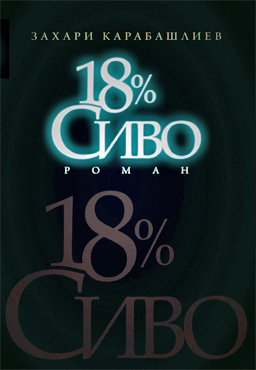
Are we people of the extremes? Do we live lives in black and white? Can you always say with certainty that one thing is right and the other is wrong? What is the basis, on which you thread, to categorize anything that happens to you? Or do we always live in the middle? 18% gray? 18% gray is the starting point of black-and-white photography. Everything needs a starting point, a basis on which to judge everything else. Darker than 18% by how much %? Or lighter by how much %? Why exactly 18%? Well, why is life that way? Why does life go forward and not backward? Why don't we die first and be born at the end?

18% Gray is a novel of travelling, of losing, searching, and finding. It's a novel of dreams, hopes, love, and rejection. It's a novel of despair. It's a vulgar brutal confession of a man on the road. Man, who has nothing to lose yet so much to find. Does Zack find it the end? Does he know what he is searching for? Can we ever know what we want, and even if we know, can we find it?

This review is full of questions since the novel poses questions. All the time. Questions about life, questions about love, questions about the world. I can't give you the answers. You have to find them in the book. Or at least, start asking yourself the right questions. The only right way to finding what you need is to ask the right questions. Before that you may ask a lot of wrong questions. Trial-and-error, dude. That's life, trial-and-error.

Saturday, 19 February 2011

The Beat Generation and Jack Kerouac


The Beat Generation of the post-war 1950s is the Lost Generation of disillusioned rebellious young men looking for freedom and self-expression. It is a religious generation on a spiritual quest back and forth in the lands of America. It is a generation that questions the validity of the so-called 'American dream' by trespassing both legal and moral boundaries in the search of personal freedom and exuberant means of living and being. It is a generation about jazz, sex, generosity, and drug abuse. It is an anti-conformist generation, which provoked many Americans to abandon their secure and boring existence and to go 'on the road', to experiment, to talk, to desire, to like, to burn, to dig...The most prominent and famous writer of this Beat Generation, Jack Kerouac, portrays his journeys through America in his autobiographical novel On the Road, a novel that deservingly finds its place among the classics of American Literature.

The origin of the "beat" may be related to "beaten" or "tired" but may as well be connected to the beat of jazz music, which largely influenced the generation of the 1950s.

Sal Paradise, the literary equivalent of Jack Kerouac, is a writer outsider in the search of a place under the sun. He is bored, disillusioned, and unhappy. Upon meeting his hero, Dean Moriarty, Paradise goes on a journey through the lands of America and Mexico, experimenting with drugs, sex, and alcohol, hitchhiking, stealing, sleeping under the sun, starving, yet engaging in exuberant and memorable experiences. In that sense, Moriarty is Sal's alter-ego - a man who lives beyond any moral or legal law, a man all about 'digging' life and its endless possibilities. Both friends rebel against the conformist American dream and go on the road to break with conventions and rules, with heightened expectations of what life should be and what life could actually offer.


Jack Kerouac and Neal Cassidy

Rebellious and unconventional, the Beat Generation was largely criticized and misunderstood during the 1950s. Formed by Jack Kerouac and his friends in Columbia University, it sets a 'New Vision' of writing and expression, contrary to the conservative literary views at that time. Allen Ginsberg, Jack Kerouac, William Burroughs and many more are the beat writers interested in people "the mad ones, the ones who are mad to live, mad to talk, desirous of everything at the same time, the ones that never yearn or say a commonplace thing...but burn, burn, burn, burn like roman candles across the night'. Most of their works are autobiographical, featuring the exuberant unbelievable experiences they had on the road.

Jack Kerouac wrote On the Road for exactly three weeks, but he spent more than sever years travelling and thinking about the novel. Most of the characters are real and the character of the famous Dean Moriarty is inspired by Neal Cassidy, together with whom Kerouac went on his road journeys. When the book was published, critics were only interested in the provocative nature of the new literary movement, the beat generation. They didn't care about Jack's life or motivation to write the book; they wanted a clear definition of "beat". Yet, Kerouac's life is very important to the nature of his novels. Just like Sal Paradise, the author hitchhiked the road, abused drugs and alcohol, and partied under the fascinating sounds of jazz, and even spent time in jail. Feeling his family was disappointed, Kerouac wanted to write a novel to redeem himself, to explain the nature of his rebellion and quest, and to make his relatives proud. On the Road, his most famous novel, helped him do that and place him among one of the most influential writers of 20th century American literature.

I have mixed feelings about On the Road. I enjoyed the reading something so different and controversial. I felt as if I was also on the road with Sal, Dean, and the others. I travelled with them through the lands of the US, I met whores, hipsters, young men and women, all looking for something outside their homes. I identified with them and their religious quest. I enjoyed literature about the exuberance and richness of experience, literature that is all about feelings and expression, literature about the struggle to confront socially acceptable norms and to live and enjoy everything, just for the sake of it. Yet On the road is a difficult novel. It jumps from event to event, without time to think or explore the idease. At one point Dean and Sal are on the road; at the next one they are digging and dancing with jazz under the influence of drugs and alcohol. The novel races through the road, giving you no time to take a breath and relax. I felt as if I, as well, was racing. To finish it, to understand it, to accept it.