Wednesday, 17 October 2012

World Without End - the sequel to the fascinating The Pillars of the Earth


After reading the more than 1,000 pages long The Pillars of the Earth by Ken Follet, you would think there is possibly not much more he can actually say about Kingsbridge and its cathedral. The novel is extensive in description, spanning more than 20 years and covering every possible spectrum of human emotion and relationship. Quite entertaining, of course, and when you finish that last page (FINALLY!) you feel a bit disappointed. You actually feel you are going to miss Jack, Aliena, Philippe and even William. However, even though you wanted it to last a little bit longer, you are definitely worried about the fact that the sequel is even longer. What could possibly Follet has to say more and would he actually ruin the good impression of the first novel with a rather weak second one?

These were the thoughts running through my head as I finally finished The Pillars of the Earth and seconds later grabbed World Without End, its appraised sequel. As I already mentioned, it was even longer than the first one - nearly 1,200 pages with the smallest font size I have ever come upon to. However, it was set nearly 200 years after the first one so Mr. Follet certainly gave himself room for a new story.

The novel begins with an awful secret. Four little children from the town of Kingsbridge (now a prosperous English market and religious center) witness a disturbing scene in the forest. The knight Thomas is nearly killed because of a terrible secret he knows and has sworn to protect. To escape his mysterious enemies, Thomas becomes a monk and joins the Kingsbridge monastery. Before that, he swears oath to Merthin, one of the children, to never reveal what he saw or that would be the end of his life. This secret (which is not revealed until the last few pages and you hardly remember that it existed) doesn't shape the lifes of Merthin, Asia, Ralph and Gwenda as the useless description on the back says. It scarcely affects their lifes so please don't always trust what some "clever" mind has written as a book description.

Merthin and Ralph are the two sons of the fallen nobleman Gerard, who after losing all his money is forced to live on the charity of the Kingsbridge monastery. The boys cannot be more different. Ralph is the younger one, but he is stronger and since early childhood he shows signs of violence. Merthin dreams of being a knight but his weak figure and father's disapproval destines him to the fate of a mason. Here comes the first of oh so many similarities between The Pillars of the Earth and World Without End. Yes, the stories are different, but the main characters are way too the same. Caris (Aliena?) is the smart and sceptible daughter of one of the richest woolers in the town. The love-hate relationship that forms between her and Merthin will span many years and several continents (a little reminder of Aliena's pilgrimage to find Jack). Ralph of course, turns out to be the biggest villain in the novel (William!) and by the 500 page we all hate him so much that we wonder which one was worse - William or Ralph.

Gwenda is the bit of fresh air that actually brings to the difference between the prequel and the sequel. She is a low born woman with a troublesome family. Her father, a most prominent impostor, barely manages to feed his family and from an early age forces Gwenda to steal. At one point he even sells her as a prostitute for a cow (I know, FOR A COW!). Seeing that she cannot get help from her mother or father, Gwenda becomes the most independent and admirable character in the novel. Her desperate love for Wulfric, who in turn longs for the stupid but beautiful Annette, shapes her life and gives her strength to fight both for Wulfric and herself. A clash against Ralph unfortunately marks a life of uncertainty and violence. Nevertheless, Gwenda is keen and observant and only her strength of will and sharpness of mind keep Wulfric and herself alive and fed.

What World Without End lacks is the strong figure of the prior of Kingsbridge. Instead the priory and the town are run by Prior Anthony, Caris's ambitious but unscrupulous and shortsighted cousin. When the bridge that connects the town to the rest of the county collapses, Merthin is set on an ambitious project to build a stone bridge and correct any mistakes made by previous builders. Similarly to Tom and later Jack, Merthin is faced with backwardness, intrigues, and cruelty.

The drama of the English-French war is exacerbated by another, more evasive enemy. The plague comes to Europe, to the UK, and to Kingsbridge itself. People are starting to doubt the ultimate power of the clergy and its prayers to cure a disease that seems out of reach. Caris, now a prominent leader of the town, attempts to wipe out widespread prejudice towards medicine and to educate people on the importance of isolating the sick and preventing the further spread of the plague. Herself and Merthin appear to be the white knights of the story, fighting at any point of time corrupted clergy, violent men-at-arms, and conservative townsmen. Their love story passes through ups and downs, with Caris being sentenced to death and Merthin travelling back and forth. Again, it quite resembles Jack and Aliena's.

Ken Follett has rich imagination and is a fascinating and engaging storyteller. He knows the human soul and he has an eye for what constitutes a good story and a good conflict. However, he is a bit too much in World Without End. The novel could have easily been 200-300 pages shorter without that altering its quality. In fact, it would have increased it significantly. In addition, the resemblance with The Pillars of the Earth is annoying at points. I guess if you don't read them one after the other, you might not find that so disturbing, but if you do (like me), you will feel you are reading the same book over again.

I am looking forward to the second part of his 20th century trilogy, Winter of the World (first one: Fall of Giants) and I sincerely hope he doesn't make the same mistake as with The Pillars of the Earth. However, nearly 2,500 pages with Ken Follet later, I definitely need a long break from him.


Friday, 12 October 2012

Magnificent Cathedral, Magnificent Ken Follet


Set in the turbulent 12th century, when medieval England is torn by a civil war, The Pillars of the Earth tells the story of the building of a magnificent cathedral in the fictional town of Kingsbridge.There is everything, and a lot of it in the nearly 1,000 pages novel: love, hatred, deceit, rape, wisdom, jealousy, manipulation, life as it was back then and most certainly as it is right now.

Tom Builder is a poor man with a big dream - he wants to build the most beautiful cathedral. Tom himself is not religious, but he sees cathedrals as the most impressive buildings in the world. They were, especially in medieval England when most people lived in something slightly better than a barn. Because of Tom's dream, though, his family is more often than not starving and homeless. When his wife dies in the woods giving birth to his third child, Tom is near desperation and abandons the baby in the woods. Meeting Ellen, a strange outlaw living in the forest, and falling in love with her is the one thing that saves him from desperation.

Ellen is one of the strong and admirable women in the novel. She lives alone with her strange son Jack after leaving the comfort of communal life nearly 10 years ago. The father of her child was wrongly hanged for a crime he didn't commit and in a feeling of desperation, Ellen cursed the church and the accusers. Her life ever since has been in opposition to the greed and hypocrisy of the ruling men - whether they are earls, priors, bishops, or kings.

Prior Philip is one of the most enchanting figures in the novel. As a child his parents were violently murdered and his brother and Philip were saved and raised by monks. His devotion to the Church and God is unshakable, yet as every human being he feels pride and desire to succeed. After becoming the Prior of Kingsbridge, Philip is set on the challenging mission to restore the priory to its former glory, to build the most beautiful church, to reinstall the market, and to transform the small village into a prosperous town.

Agains Tom, Philip, and Jack, who becomes Tom's apprentice and most devout follower stand William, the earl of Shiring and Waleran Bigod, the ambitious Bishop of Kingsbridge. William is probably the only completely evil character in the novel, with nothing human in himself. He is greedy, sexually maniacal, and extremely violent and ruthless. His hatred towards the people of Kingsbridge is well connected to Aliena - the daughter of the former earl of Shiring. When she refuses to marry him, he violently rapes her and throws her out. Now Aliena has united with Prior Philip and the villagers of Kingsbridge and this makes William's desire for revenge even stronger and bloodier.

It is impossible to describe the pathos of this epical story. Spanning from one generation to another, Follet creates rich characters, neither saints nor devils (excluding William of course). The reader feels drawn to the destinies of Ellen, Tom, Jack, Aliena and Philip, trembles when evil threatens to overwhelm justice and leaps with joy when the building of the cathedral is again on its way. Despite Follet's rather negative fame for writing slightly shallow thrilers that can hardly excite a 10 year old, in The Pillars of the Earth and World Without End (so far) he is at his best. I quite enjoyed him in Fall of Giants but to be perfectly honest, he is doing a much better job identifying with the medieval society than with the intriques surrounding WWI.

Monday, 10 September 2012

The Bastard of Istanbul - Elif Shafak's Forbidden Book

I enjoyed Elif Shafak's Forty Rules of Love as much as I would enjoy a light slightly over positive book about love, gratitude and selfelssness. Yet, it wouldn't make it to my favorite lists and Shafak for sure wouldn't make it to the authors I follow with excitement. I find her rather too obvious, an author whose writing is too much telling rather than showing. Her prose is so understandable without the slightest effort, it is digestable even for the under-average reader, which I find a bit boring.


Nevertheless, when I read that her novel The Bastard of Istanbul was controversial in Turkey and the author herself was sentenced to three years of prison because of an offense towards the Turkish community, I felt there might be something worth it there. I mean, reading a forbidden book (similarly to doing all that forbidden stuff) is exciting itself. It feels as if you are crossing an invisible boundary and even the simple act of reading a forbidden book might be the spice that makes your day unordinary.

In her second novel in English, Shafak confronts and openly critisizes her country's violent past, in relation to the Armenian genocide of 1915. The plot transcends between continents and years focusing on two families - the Kazanci in Istanbul and the Stambulyan in the US. The Kazanci family is a colorful picture of women, who bear bravely the family curse: all Kazanci men die early. Seven women with seven different personalities from three generations try to coexist between the old Istanbul and the new Istanbul. Banu, the oldest sister, is a self proclaimed clairvoyant; Cevriye is a widowed and depressed school teacher; Feride is an obsessed hypochondriac, who comes up with a new sickness and a new hair color every week; and finally my personal favorite, Zeliha is the black sheep of the family. At the age of 19th she gives birth to Asya, the bastard of Istanbul. She wears short skirts and high heels and makes a living as a tattoo artist. The daughter has inherited her mother's rebelious nature. Asya likes Johnny Cash, philosophy, and random sexual affairs. She smokes, drinks, and openly rebels against the absurdity of her family.

On the other side of the world lives Armanoush, trapped between the Armenians and the Turkish. Her parents separated when she was young, mostly due to her father's strong and obsessive Armenian family. Her mother later married to Mustafa, the Kazanci estranged brother and Armanoush found herself in the middle of a battlefield. Desperately looking for her identity, she sets on a journey to Istanbul.

As much as the two girls are different, Asya and Armanoush quickly form a bond, ignorant of the circumstances that actually tie them closer than they can imagine. The two wander around the colorful streets of Istanbul, talking about politics, confrontation, the genocide, the past, and the future. However, the characters Shafak draws are a bit unconvincing. Asya and Armanoush talk more like 40-year-olds than like two teenagers but through their dialogues Shafak brings up the issues she would like her readers to mostly think about.

The family connections in the novel are so complicated that I often found myself stopping for a while trying to figure who was whom. Shafak slowly reveals the puzzle but it takes more than 2/3 of the novel so that things start to slowly make sense. I literally felt I needed a family tree to understand who came from where. Besides that, the novel is entertaining but largely predictable. I knew long before the end what the "terrible secret" would be and I was disappointed to be right.

As for why Shafak was sued, the novel is controversial only in the context of the Turkish extremists. The Armenians are bound by their sufferings in the pasts, wanting the Turks to admit to the "genocide". They feel as victims, a feeling that they pass on generation after generation, and honestly, a feeling that if lost, wouldn't tie them as strongly as a nation. The Turkish are separated: half of them do not admit the genocide ever taking place, and the other half (including the Kazanci family) have heard of it, feel sorry for the Armenians, but do not understand how they can be blamed for any of it.

Overall, a good book but I found most of the characters (excluding Zeliha) utterly unconvincing and I just couldn't connect with them. At points I felt Shafak was inconsistent in her descriptions and I couldn't form a coherent image for almost anyone. On the positive side, she does a good job bringing up a bit of magical realism (which I am a huge fan of). The djins coexist quite naturally with the Kazanci, bringing some fresh air in the rather stagnant novel.

Wednesday, 5 September 2012

Italo Calvino's If on a Winter's Night a Traveler - For the love of reading


All the novels I have read are for other people. Interesting, challenging, disturbing, motivational, whatever they might be, they are still for other people. I have identified with them, differentiated from them, loved them and hated them, but I was never them. Calvino is the only writer (so far), who writes about me. Puts me in the center of his novel. Actually, he puts you, as well. Yes, you, the passionate reader, for whom reading can easilly be a substitute for breathing. Yes, you, who would prefer a good book over anything everytime, whose eyes are glued on the novel, who derive immense (almost sexual) pleasure from a literary masterpiece. You, me, us, we the readers are the characters of Calvino's If on a Winter's Night a Traveler.

The novel is structured as 10 chapters in 2nd point-of-view (adressed towards you and me, the readers) alternating with 10 beginnings of different novels. The poor reader starts a novel, only to realize everything but the first chapter is missing. He sets on a journey to discover the rest, driven by his reader passion and restlessness. Unfortunately, he doesn't discover the rest of the novel, but the beginnings of another 9 novels. What a complete torture for any reader. You just started something and you are getting curious about what the rest is going to offer, how is it going to make you feel, what it is going to tell you about the world, and how it is going to change you and BAM, you are deprived of that greatest of all pleasures.

To make things easy for us (the reader) Calvino gives us a female reader. To accompany us in the search, to share our reading obsession, and to put a little love touch, without which every self-respecting novel is just words on a piece of paper. The female reader is the personification of the perfect reader. She immerses herself in the world of books. She reads several novels at a time because neither is enough to satisfy her book hunger. She refuses to meet the authors because their mortal body would only ruin the image she has through their voice in the novels. For her, you the reader, travel the world to find that special book or that special self. And along the way, you (me, us) discover the essence of reading. Calvino looks at it from several possible angles, presenting a different literary form with each of the new beginnings. He attempts to be 10 different authors and to his honor, he succeeds. Whatever the new novel is about, the chapter before that has already hinted to. At first it might seem Calvino just lacked ideas to write a whole story, but if you come to think about it, he is a genius indeed.

If on a Winter's Night a Traveler is a strange novel. It takes sometime to get accustomed to Calvino's unusual style. I was even annoyed in the beginning, as I felt completely lost, but once I found my place as "the reader" the novel indeed turned into something else. Calvino in this book needs to be experiences with the soul and not with the mind. It is difficult to say what If on a Winter's Night a Traveler is about. However, the most important fact is that it will appeal to everyone for whom the reading world is an unseparable part of the real world.

Tuesday, 4 September 2012

1Q84 or the world with two moons


Even before I started 1Q84, I was trembling with a sweet impatience and anticipation. The days, weeks, and months passed, yet I knew somewhere a different world was awaiting me, the world not of 1984 but of 1Q84.

A friend of mine said I would absolutely love 1Q84. Well, if she meant I would actually be staying until 4 o'clock because my hands were glued to the book and my eyes - to the story, she was right.

People's general reactions to Muramaki's novel were two: 1: This is a huge book (yes, Murakami indeed overdid it by writing 900+ pages) and 2: I thought 1984 was written by Orwell. Let me start by the first question and for the first time by something negative. Indeed 1Q84 could have been a lot shorter. Murakami spends a lot of pages repeating and explaining stuff he already said and explained. At points I felt underestimated as if I am this shallow reader, who constantly needs to be reminded about the sequence of events. In his defense, Book 3 was originally published separately from Book 1 and 2 and within nearly a year time span, so I guess it was somewhat necessary. However, when you read Books 1, 2, and 3 one after the other, you sincerely get outraged at this constant repetition.

1Q84 is a play of words as in Japanese 9 and Q are written with the same symbol. 1Q84 is also a reference to Orwell's famous dystopian novel. The characters in the novel find themselves living in a parallel world, a world where two moons co-exist, where the Little People create air chrysalis and speak through it to the receivers, where there are a dohta and a maza. Yes, you wouldn't understand a word I am saying, but explaining it would ruin the whole novel. And as repeated constantly throughout 1Q84: If you don't understand it without an explanation, you wouldn't understand it with an explanation.

The year is 1984 (not for a long time) and the city is Tokyo. Aomame is a 30-years-old woman, who seems to be living quite an ordinary life - she is a fitness instructor by day and a sexually active hunter by night. Only two people know of her secret life - Aomame is a killer. She eliminates men, who abuse women. On the way to her next assignment, Aomame takes a wrong step (or rather a wrong staircase) and the world she believed she lived in changes completely.

Tengo indeed lives an ordinary life. He is a math teacher, who writes novels in his spare time. When his extravagant editor Komatsu suggests that Tengo rewrite the promising novel of a 17-year-old girl, Tengo doesn't suspect that this is going to turn his world upside down. Fuka Eri is a mysterious girl, whose first (and only) novel Air Chrysalis tells THE fantastical story of THE Little People, who affect the world's direction in mysterious ways. At first to Tengo,this story is nothing more than a girl's rich imagination. However, similar to Aomame, he starts noticing weird things around him.

Murakami quite extensively focuses on religious cults. One of them, to which Aomame's parents belong, believes in the destitution of the human body as a way to reach God. Its followers refuse even blood transmission, as it is a unnatural intervention into what God created and destroyed.

The second one is a more mysterious cult. Sagikake looks like a commune, where people disillusioned by capitalist society have retreated to grow their own food and to live in harmony and peace. As Fuka Eri's Air Chrysalis becomes popular, both Tengo and Aomame start feeling that it might be describing events in the cult. And both of them become unnaceptable to Sagikake.

The story in Book 1 and 2 alternates between Aomame and Tengo, but in Book 3 Murakami brings some fresh air and a new perspective in the character of Ushikawa, an investigator hired by Sagikake to track down Tengo and Aomame. His reflections, along with Tengo's and Aomame' help create a clear picture of the changing world and of the role the cult, the Little People, Air Chrysalis and even Tengo and Aomame play in it.

Tengo and Aomame's paths intertwine as they become closer to closer to realizing that they might be in this world just to meet again. They have shared a special bond as children but 1984 doesn't allow them to reunite. Both of them start believing that this special place with two moons exists for them and because of them.

1Q84 is entertaining and obsessing as you scroll through the lines to uncover the mystery of the Air Chrysalis and The Little People and to see Aomame and Tengo reunited. As I reader, I felt I am walking slowly next to them, patiently waiting for that perfect moment to meet.

More on Murakami: South of the Border, West of the Sun

Saturday, 1 September 2012

What is your favorite book

Probably one of the most inane questions I've been asked. So when confronted with a stupid question, answer with another question: "In what sense?"
The book I would like to re-read over and over again? The book I've read the most and know by heart? The book, which style I admire? The book that made me think the most? The book that inspired me to do something? The book that I simply couldn't rest and kept reading until my eyes burned? The book I cried to for the first time?

Many definitions to the question of my most favorite book and as many answers, for that matter. Nevertheless, I myself felt inspired to find the answer to that question. Of course, the moment one book popped into my mind, so did several others and no matter how hard I tried, I just couldn't put one on top. It felt as such an offence for the rest contestants, which made it to the final round. So, instead, I decided to give all of them some credit (my favorite books, that is) and compile a list. So there it is the list of my most favorite books, in categories. Before anyone even opens his or her mouth to say, "You can't say this is the greatest book", yes I can. This is my blog; my opinion and frankly I can even say Harry Potter is a classics, if I wanted to!

1. The greatest love story ever written. Period
Love in the Time of Cholera - Florentino Arisa, Fermina Dasa and Juvenal Urbino show the different faces of love in times of cholera, which are also valid in times of terrorism. You can like someone and spend your life with him being happy, without necessarily feeling extreme passion. This is OK and happens constantly. You can f*ck everything that moves and still love that one person with all of your heart. This is also OK and also happens constantly. You can get together with your true love even after waiting for more than 50 years. OK, this doesn't happen that often but it is still OK. Incredible,in every possible way. Movie is great too and Javier Bardem is too hot to bear. My most favorite quotes is also from that book,a quote that passionately waits for my body and mind to decide where it should be most appropriately tattoed and how to co-exist with my present tattoo:

The only regret I will have in dying is if it is not for love.
Ще ме е яд да умра само заради едно - че няма да е от любов.


2. The best dystopia
1984 is the classics of the classics. Brave New World, A Clockwork Orange, Fahrenheit 451, and We complement this amazing list but Orwell and his Big Brother most effectively (and rather scarily) describe a near-by future, where those who control the present, control the past, and those who control the past, obviously control the future. Orwell gives a bit of hope to the characters, only to smash it at the end. Big Brother sees everything and there is no way to escape his grasp.


3. The book that inspires me
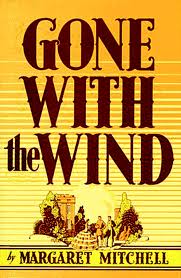
Gone with the Wind
Scarlett o'Hara is probably the strongest, most admirable and most destructive female character in world literature. She is egocentric, selfish, and self-sufficient, yet she possesses that amazing strength of character and will to survive and to win at any cost. People's opinion doesn't matter to her as long as she is convinced that what she is doing is right. Whenever I feel down/ugly/stupid/irrelevant/invisible/grotesque/funny (and not in the good way) I think of Scarlett, a woman to admire.
After all...tomorrow is another day! Something all of us should be aware of when things start to get rough.


4. My book form
The Unbearable Lightness of Being
I love Kundera and his way of showing the absurdity and fatuity of the world we live in, the truth about loving relationships, the difficulty of connecting with others, all of this under the blossom trees of Prague. Can Kundera and I be related because I sometimes feel he would understand better than even my parents would?


5.Who is John Galt?
Atlas Shrugged - Rand's phenomenon is hated by half of the world and adored by the rest. I have never met someone with a middle-ground moderate opinion about it. Which makes me love it even more. I am always suspicious towards anything that the majority of people praise. There must be something wrong with it. As with people, if everyone likes you, most probably no one likes you that much. Atlas Shrugged is controversial, politically challenging, and at points outrageous. But it is still a phenomenon in world literature, it is beautifully written, and Rand's philosophy of the man and his abilities at the centre of the world is absolutely admirable. Hate or love it, everyone must read this book. EVERYONE.


6. The book I know by heart
I have re-read Pride and Prejudice over and over again since I was about 11 and my mum gave it to me as her favorite book. Darcy and Elizabeth's love story is just what the world needs - he is an arrogant rich man and she is a witty young woman, who is the only one not afraid to stand up to him. The origin of modern sugarcoated movies, Pride and Prejudice is humorous, satiric, and more analytical and serious than it might seem on the outside. Austen is rumored to have described her own family and traditions in the book. Her heroine Elizabeth is one of the first controversial female characters, who show to the Victorian society that the woman can actually be smart, educated, and equal to the man.

It is a truth universally acknowledged, that a single man in possession of a good fortune, must be in want of a wife.

The opening sentence of the novel and it is as famous as the novel itself.

These are 6 books that if you haven't read, well YOU HAVEN'T LIVED!

Saturday, 18 August 2012

Words of Wisdom vol.3

My reading behavior has been beyond approach lately and I am quite tempted to excuse it with "Oh, I am an investment banker, I work such long hours". Don't even get me started on the pride with which investment bankers share the hours they work it. As if it is the greatest accomplishment in life to be in the office from 9 until infinity.

Anyways, I have been bad myself, reading a book every week (in the good weeks) and writing reviews every once in a while (when I actually feel I want to see a computer again).

This doesn't mean, however, that my so called wisdom has dried out. I am still one of those people that probably most of my friends have banned from Facebook newsfeed because once in a while I feel like sharing a deeply profound status. I am not sure what people's opinion is (frankly I don't know if I care) but I feel I need to cast some opposition to the following:

1. Annoying pictures of cute bears, babies, dogs, cats, mice, whatever
2. Pictures of coffee accompanied by "Good morning, it's Monday. Have a wonderful week everybody". Monday by far is the worst day of the week and I strongly believe it should be banned. It actually makes me sick seeing those positive people on a Monday morning when I fucking wonder why the alarm has rung only a few minutes after I went to bed.
3. Dramatic statuses (i.e you don't love me but you lose because I am... and I am strong enough and....just play Cher's Strong Enough and you get the point)
4. Endless 9gag postings - yes, I love 9gag myself, I can go there if I want, I don't need to see it constantly.
5. Pictures from the seaside - Now this is entirely personal but people I AM STUCK IN THE OFFICE PLEASE DON'T SHOW ME HOW MUCH FUN YOU ARE HAVING!

So I feel by far that my occasional "wisdom" statuses are actually doing some good. First, I avoid being overdramatic. Second, I assume it would be nice to read something profound you haven't hear (most probably) before. Third, I know I am sounding overconfident, but come on, I do have some cool statuses.

Going back (finally, this has been one annoying word vomit) to Words of Wisdom vol. 3


I am indeed a king because I know how to rule myself.
~Pietro Aretino

The worst mistakes are made by people who have no doubts.
~my Risk Management lecturer at HEC

"Men have forgotten this truth," said the fox. "But you must not forget it. You become forever responsible for what you have tamed."
~The Little Prince

There was only one catch and that was Catch 22, which specified that a concern for ones own safety in the face of dangers that were real and immediate was the process of a rational mind. Orr was crazy and could be grounded. All he had to do was ask; and as soon as he did he would no longer be crazy and would have to fly more missions. Orr would be crazy to fly more missions and sane if he didn't but if he was sane he had to fly them. If he flew them he was crazy and didn't have to; but if he didn't want to he was sane and had to. Yossarian was moved very deeply by the absolute simplicity of this clause of Catch-22 and let out a respectful whistle.
~Catch 22 Joseph Heller

Nobody can face the world with their eyes open all the time.
***
Most of what matters in your life takes place in your absence.
***
"You be respectable sister," she said, "Me, I'll be alive."
***
I no longer want to be anything except what who I am. Who what am I? My answer: I am the sum total of everything that went before me, of all I have been seen done, of everything done-to-me. I am everyone everything whose being-in-the-world affected was affected by mine. I am anything that happens after I've gone, which would not have happened if I had not come. Nor am I particularly exceptional in this matter; each "I", everyone of the now six-hundred-million-plus of us, contains a similar multitude. I repeat for the last time: to understand me, you'll have to swallow a world.
***
Memory has its own special kind. It selects, eliminates, alters, exaggerates, minimizes, glorifies, and wilifies also; but in the end it creates its own reality, its heterogeneous but usually coherent version of events; and no same human being ever trusts someone else's version more than his own.
~ Midnight's Children Salman Rushdie

-"Just remember that the things you put into your head are there forever," he said. "You might want to think about that."
-"You forget some things, don't you?"
-"Yes. You forget what you want to remember and remember what you want to forget."
~The Road Cormac McCarthy

It's good that you feel pain. If it stopped hurting, you'd have something seriously wrong with you.
***
If you can love someone with your whole heart, even one person, the there's salvation in life. Even if you can't get together.
~1Q84 Haruki Murakami

...and a mind needs books as a sword needs a whetstone if it is to keep its edge.
~ A Clash of Kings George R.R. Martin

Words of Wisdom vol.1
Words of Wisdom vol.2

Tuesday, 14 August 2012

World War Z - it might be closer than we think

In World War I the world fought imperialism. In World War II it opposed the Nazis. In World War Z, however, humanity is facing a somewhat more elusive enemy. How do you defeat someone, who cannot be killed because he is already dead?

World War Z is exactly what the title says - an oral history of the zombie war, a war set in the nearby future, which nearly eradicated humanity as we know it. Brooks is a journalist from the United Nations, whose role is to supplement the official 'facts and figures' report of the zombie war with a personal touch. That is, the 10-years-after account of the war lacked any human perspective;it was merely a historical representation of the war events. Brooks feels the human component is vital to the story - as already discussed human memory is fleeting and fragile. Without the personal story of the survivors, humanity will easily forget and eventually face the same problem again. Thus, the journalist goes on a global adventure to interview people from differen countries, social classes, and ages, who have fought and survived the Zombie War. The whole novel is set in the form of personal interviews and the variety of voices and characters forms a complete picture of what the world would look like if faced with an epidemic of that scale.

The body-eating, crawling, grotesque zombies are indeed cool but don't let Brooks's novel fool you that easily. More than a post-apocalyptic horror tale, World War Z uses a zombie outbreak as a metaphor for any of the challenges we currently experience (poverty, global warming, diseases, terrorism). It starts quite naturally - in a remote village in a third world country as a virus (resembling quite closely the outbreak of AIDS for example). The developped countries' politicans act as they have always had - completely ignoring whatever is happening outside their well organized countries. Placebos start appearing while the politicans close their eyes, following a rather common but obviously unsuccessful approach - as long as we ignore the problem, it doesn't exist. As with many other contemporary challenges, the moment to theoretically control and stop the disease was long past when the men of power finally realized there was something to be done. Zombies (terrorism, aids, global warming, you name it) already spread across all continents threatening to destroy a race that fallaciously (still) believes it is superior to nature. We are born and raised with the idea that humanity cannot seize to exist since we are too clever to do so. Unfortunately, Brooks shows that with the current political, economic, and social order, we are absolutely unprepared to face any major problem with a global outreach.

So the Great Panic is a fact. From the USA to Russia and from the Nordics to Africa governments realize something must be done. The first reactions are political - the Pakistani blame the Israeli, South Korea starts feeling threatened by North Korea, and the USA and Russia feel the great urge to resume the Cold War. At times Brooks is terribly smart (and unfortunately right). Quite a long time is lost in the zombie war (as in many other conflicts) when countries point their fingers at each other instead of at the common enemy. Meanwhile, the undead are rising and slowly threatening to overwhelm the living. Surprisingly (or maybe not; totally depends on your political orientation) the rather totalitarian countries such as North Korea and Russia are the first ones to successfully start defeating the zombies. I am not advocating for any particular regime but people in that countries always had what it took to fight - a sense they were belonging to their country and a patriotic feeling, which made them proud to die in the hands of a zombie so that the great Mother Russia can survive. The individualist capitalistic society of the USA was the most severely hurt. Suddenly the smart white-collared CEOs and CFOs became redundant. What society needed was strong and skillful workers. The plumber became higher than the manager. Brooks ingeniously shows how quickly social order can be reversed in times of crisis and how the people that think themselves indispensable to the economic development of the world will be the first ones to take on the zombie skin.

As with all wars, there are winners and there are losers. Although in Brooks' world it seemed as if the whole world was the loser. Yes, indeed some nations (especially the Nordics, since zombies tend to freeze in low temperatures) did better than others (I am not saying it but I indeed point to the Americans) but overall the result was a mass anarchy and chaos, several hundreds of millions dead (or undead) and major disatisfaction and lost of faith in the ruling governments. What will happen if the world is faced ever with such a devastation? Brooks gives a similar answer to McCarthy in his apocalyptic novel The Road:WE ARE NOT PREPARED.

Falaciously we believe we can survive and beat any disaster that comes our way. Hurricanes and earthquakes have shown us mother nature is and always will be more powerful. The War on Terror has clearly proved that politicans are more concerned with their public face instead of with making the right decisions. The great talks of cooperation and help will be over instantly the moment humanity faces an unknown enemy. At that point it will be every man for himself.

Entertaining, witty, ironic, and humurous, Brooks's World War Z is a must read for anyone with a least a bit of common sense, who is not blinded by big words and fallacious promises. On the plus side, there are some great zombie moments, which made even me look with suspicion behind my back. Strongly recommended!

Saturday, 11 August 2012

The Book of Laughter and Forgetting - Milan Kundera

After reading The Unbearable Lightness of Being and realizing that this was my book form (if I ever become a book, this is what I'll be) I became determined to read everything Kundera has ever written (ok almost everything). That is why when I stepped into a bookstore on Brick Lane a couple of weeks ago I ignored the piles of books on the way and went straight to a corner, where I was told Kundera is hiding. And there it was, a shelf of 6-7 books and no way of picking. That's when I saw The Book of Laughter and Forgetting. The title immediately caught my attention. I would never connect forgetting and laughter, let alone put them in the same sentence on in the same title of a book. But again, if you come to think about it, you wouldn't put 'unbearable' and 'lightness' together either.


This book is a novel in the form of variations. The various parts follow each other like the various stages of a voyage leading into the interior of a theme, the interior of thought, the interior of a single, unique situation, the understanding of which recedes from my sight into the distance. It is a book about laughter and about forgetting, about forgetting and about Prague, about Prague and about angels.

That is how Kundera himself describes his novel and I doubt I could find a better way. The Book of Laughter and Forgetting is comprised of seven unrelated parts, all set in 1970s Bohemia, Czech Republic, during the years of the Russian occupation. The somehow independent from one another stories combine smoothly into a general feeling of impeding doom, of a disaster waiting to happen, of a despair that suffocates. One can easily recognize there are two driving themes - laughter and forgetting. The author explores their variations in the political, philosophical, and everyday sense creating rich characters, rich stories, rich experiences.

Forgetting. We all do, unfortunately. Sometimes I do pray to forget because the shame of what I did in the past obstructs my living in the present and my plans for the future. These prays are usually answered. No matter what we do, we forget. I realized it a couple of months ago when I was looking at a picture from my first school and I realized I have forgotten half of the names of my classmates. That is when it struck me and I felt a slow despair rising slowly. If i don't remember my past, where is my future?

The future is only an indifferent void no one cares about, but the past is filled with life, and its countenance is irritating, repellent, wounding, to the point that we want to destroy or repaint it. We want to be masters of the future only for the power to change the past.

In Kundera's world forgetting is an unescapable sin. Our existence is constantly marked and affected by forgetting. Memory is fragile and fleeting, yet memory and only memory determines the individuals we are. In the political sense, forgetting is the power of communism, memory - its worst enemy. In Russian occupied Bohemia the prime minister is the minister of forgetting. The collective memory is altered, transformed, changed, or erased to fit a new regime. Without memory, the people are fleeting in a void. Indeed:

The struggle of man against power is the struggle of memory against forgetting.

In a personal sense forgetting is even worse. Tamina and her husband left Prague as political enemies only for her husband to die a few months later abroad. Ever since Tamina has been submerged in her daily life as a waitress only to realize she has forgotten her past. She clinches to the only hope she has of recovering it - the diary she kept when she was happy. Without that diary, which follows with details the ups and downs,the happiness and the sorrow, the sex and the fightings, Tamina cannot see a future for herself. It seems weird to stick to the past when the future is awaiting for u. Yet, how are you to build a future if you have forgotten who you were before? The scariest thing is that we know the things we have forgotten are hidden somewhere in the brain (biology or whatever, but in fact everything we have ever seen or read is stored in the neurons) but we cannot retrieve it. In that sense is man's biggest agony.

In my life forgetting has been my agony. No matter how bad I have felt, I tend to forget and I keep making the same mistake over and over again just to feel the same emptiness, the same despair early in the morning when nothing makes sense, the same feeling it's only me who is standing, while the whole world is revolving. I have forgotten how much it hurt and I did it all the same.

And yet, as the coin has two sides (and the living is unbearably light): Kundera points out:

We must never allow the future to collapse under the burden of memory.

That is what I will always adore about Kundera. Never a straight answer and never a magical way to eternal happiness. Life is dual, being is unbearable, the end is doomed and we have to make our peace with the imperfections of the world.

From the forgetting to the laughter. I am not really sure how to make the transition but there is a quote that has stuck in my mind:

The first time an angel heard the devil’s laughter, he was dumbfounded. That happened at a feast in a crowded room, where the devil’s laughter, which is terribly contagious, spread from one person to another. The angel clearly understood that such laughter was directed against God and against the dignity of His works. He knew that he must react swiftly somehow, but felt weak and defenseless. Unable to come up with anything of his own, he aped adversary. Opening his mouth, he emitted broken, spasmodic sounds in the higher reaches of his vocal range (a bit like the sound made on the street of a seaside town by Michelle and Gabrielle), but giving them an opposite meaning: whereas the devil’s laughter denoted the absurdity of things, the angel on the contrary meant to rejoice over how well ordered, wisely conceived, good and meaningful everything here below was.

The angel and the devil faced each other and, mouths wide open, emitted nearly the same sounds, but each one’s noises expressed the absolute opposite of the other’s. And seeing the angel laugh, the devil laughed all the more, all the harder, and all the more blatantly, because the laughing angel was infinitely comical.

Laughable laughter is disastrous. Even so, the angels have gained something from it. They have tricked us with a semantic imposture. Their imitation of laughter and (the devil’s) original laughter are both called by the same name. Nowadays, we don’t even realize that the same external display serves two absolutely opposed internal attitude. There are two laughters, and we have no word to tell one from the other.


Laughter in Kundera's world carries infinite meanings. It is the devil's creation. It is the enemy of love. It is what tears us away from the world and throws us into our own solitude. It is an escape and a protection from reality.

I just realized this review is an absolute vomit of words and ideas that don't seem to make sense. In my head they do and they represent the way I was feeling after finishing The Book of Laughter and Forgetting. It took me a month to write a review and I realized, I did forget a lot. But I will laugh the devil's laugh now and end with my most favorite quote.

Every love relationship rests on an unwritten agreement unthinkingly concluded by the lovers in the first weeks of their love. They are still in a kind of dream but at the same time, without knowing it, are drawing up, like uncompromising lawyers, the detailed clauses of their contract. O lovers! Be careful in those dangerous first days! Once you've brought breakfast in bed you'll have to bring it forever, unless you want to be accused of lovelessness and betrayal.

Thursday, 12 July 2012

A Clash of Kings - the second book of A Song of Ice and Fire is bloodier and darker


The second book from Martin's epic A Song of Ice and Fire largely reminds of political elections in Bulgaria. Five kings are fighting for the Iron throne and almost all of them have no claim on it whatsoever.

Robb Stark is determined to avenge his father's death and to wipe of the face of the earth every Lannister still standing. Only 15-years-old and with the help of his notorious mother Cathleen Stark, he leaves Winterfell to his younger brothers and marches south to spread justice. After his father unfortunate death and Ned Stark's murder, the spoiled and annoying Joffrey is free to play king and even the powerful Cersei cannot stop him spilling blood back and forth. However, his comfortability on the Iron Throne is shaking as the truth of his mother and father/uncle incest is coming to surface.

Robert Baratheon's brothers Stannis and Renly also join the party. Stannis, most probably the most righteous heir to the throne, chooses not the way of the sword, but the way of dark magic. Abandoning the old gods, he chooses the God of Light and his representative the red-haired Melissandre. One must point out that Stannis is the least desired king as his personality cannot be further away from charming and exciting the masses. Renly, on the other hand, is the pretty, attractive, young, and rather impulsive candidate-king. Forming a strategic alliance with Highgarden by marrying one of the lord's daughters, he secures for himself a strong army to try and storm King's Landing.

I must revise my statement - it is actually four kings and a queen. Daenarys (or simply Danny) is without a doubt the most boring and redundant character in the novels. So far her successes include burning Khal Drogo and accidentally awakening her dragons and settling in Qarth, the most beautiful city in the world (according to its people). Danny indeed lacks experience and good judgment (which she compensates with looks) but she has her loyal dog next to her (Jorah Mormont), who, to be honest, is far more concerned with how to get into her pants than to help her take Westeros back.

One must mention Theon on top of these 5 kings. Upon his return to the Iron Islands after being Ned Stark's ward (or prisoner in Theon's eyes) he discovers he is a stranger at home. His younger and manly sister is now his father's and his people's favorite for the throne. Theon must prove that he is worthy of the iron blood and takes a rather bold but stupid decision to turn against the people he grew up with. Even though I quite like Theon, he lacks the wits and the patience to be a conqueror and his immature act would cost him more than his father's disapproval and his sister's contempt.

A Clash of Kings is indeed bloodier and darker. Martin once again reminds us not to make a character a favorite, because everyone can easily be killed in the next chapter (one of the aspects I simply love about Martin's style; no one is safe from the power of his pen). There are more battles with great descriptions in the second part and one gets the feeling that while the first one was more about strategy and wits, the outcome in the second one will be determined by spears and swords. The magical unites with the historical to create a battlefield, where strength, wits, gods, and luck interact, where alliances are broken and enemies found in a mere second, and where nothing is certain except the fact that Tyrion is a dwarf.

Some people share the belief that the second book was much more boring and predictable than the first one and that Martin is lowering the quality level of his epic story. I couldn't disagree more. While A Game of Thrones was much more an introduction to the Land of Westeros, the noble houses, and the conflicts, in A Clash of Kings we are so to say at home already. I have my personal favorites (yes, I wouldn't surprise anyone if I say Tyrion but I kind of have been fond of Theon as well; don't ask me why, I still don't have an idea). The second novel builds upon the first with characters becoming more rounded, while the reader has the chance to see them in situations the first book didn't offer. Jon Snow falling in love (or in lust) and questioning his oath to the Men of the Watch, Cersei showing some humanity after all, and Tyrion struggling between his loyalty to his family, his affection for the whore Shae, and his inherent inclination towards justice are not to be missed. Martin hasn't become bored or predictable yet, but he becomes wordier and wordier. His descriptions are thorough, his style insightful, and his imagination beyond admiration. Truly one of the most notable science-fiction authors of our time and one who must be followed closely.